Pumpkin Smith Island Cake
- Prep Time 1 hour 30 minutes
- Cook Time 10 minutes
- Total Time 4 hours
- Yield 20 servings
- Category Dessert
- Method Baking
- Cuisine American
Pumpkin Smith Island Cake
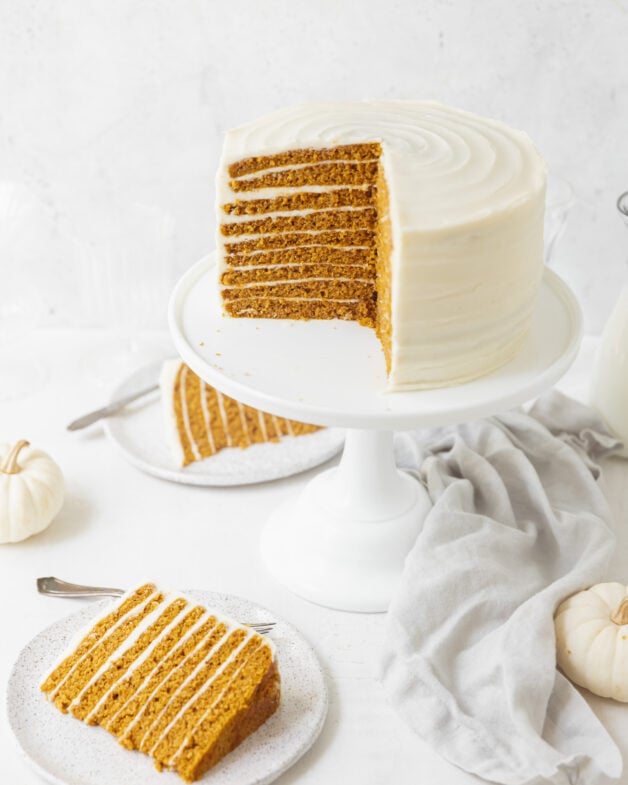
This Pumpkin Smith Island Cake has 9 thin layers of spiced pumpkin cake stacked with tangy cream cheese frosting. The ultimate fall and Thanksgiving dessert!
- Prep Time 1 hour 30 minutes
- Cook Time 10 minutes
- Total Time 4 hours
- Yield 20 servings
- Category Dessert
- Method Baking
- Cuisine American

Ingredients
Units
- For the pumpkin cake
- 1 3/4 cup (364g) granulated sugar
- 1 cup (210g) vegetable oil
- 5 large eggs, at room temperature
- 1 15 ounce can pumpkin puree
- 2 teaspoons vanilla extract
- 3 cups (384g) all-purpose flour
- 1 tablespoon ground cinnamon
- 2 teaspoons ground ginger
- 1 teaspoon ground nutmeg
- 1/2 teaspoon ground cloves
- 2 teaspoons baking powder
- 1 teaspoon baking soda
- 1 teaspoon salt
- 2/3 cup (160g) milk
- For the cream cheese icing
- 1 1/2 cups (316g) unsalted butter, at room temperature
- 8 cups (960g) powdered sugar
- 8 ounces cream cheese, at room temperature
- 2 tablespoons (30g) milk
- 1 tablespoon vanilla extract
- 1 teaspoon salt
Instructions
- First, make the cake. Preheat the oven to 350°F. Line the bottom of three 8-inch round cake pans with parchment paper and grease the sides with cooking spray. You’re going to use these cake pans 3 times each (totaling 9 layers of cake), so take this time to cut out 6 more circles of parchment paper for later. Set everything aside.
- In a stand mixer fitted with the whisk attachment, add the sugar, oil and eggs and mix on low speed until combined so the oil doesn’t fly everywhere. Use a silicone spatula to scrape down the sides and bottom of the bowl, then add the pumpkin and vanilla. Beat on medium-high speed until combined, about 1 minute.
- In a separate mixing bowl combine the flour, cinnamon, ginger, nutmeg, cloves, baking powder, baking soda, and salt. With the mixer on low speed, alternate adding in the dry ingredients and the milk in 3 additions (you’ll add half the dry, then all of the milk, then the other half of the dry). It’s okay if the batter still has a few lumps in it–you don’t want to overmix.
- Use a 1 cup measure (or better yet, weigh the batter and divide it in 9 perfection portions) to scoop 1 cup of batter into each of the prepared cake pans. You want to be super precise here for those lovely even layers—use the back of a butter knife to level off the cup measurement, and use a silicone spatula to scrape all of the batter out into the pan. Use the spatula to spread the batter to the edges of the pan. The layer will be very thin, but this is correct. Bake until the cake has risen and the top springs back to the touch, 11 to 13 minutes.
- Place the cake pans on a cooling rack and allow to cool until just warm to the touch. To remove the cakes from the pans, drag a butter knife around the edges of each cake, then carefully flip each cake out onto a plate, peel away the parchment paper, and re-invert them, right-side up onto a cooling rack to cool completely, about 20 minutes.
- Use a paper towel to wipe away any crumbs inside of the cake pans, then place a new sheet of parchment paper on the bottom and re-grease the sides with cooking spray. Pour another cup of batter into each of the cake pans and repeat the baking process until all 9 layers of cake are baked and cooled.
- Once the cakes are cool, make the cream cheese frosting. In a stand mixer fitted with the paddle attachment, add the butter and 3 cups (360g) of the powdered suga. Beat on medium-high speed, scraping down the sides and bottom of the bowl as needed with a silicone spatula, until the frosting is smooth and combined, about 1 minute. Add the cream cheese, the remaining 5 cups (600g) powdered sugar, milk, vanilla, and salt, and beat on low speed until smooth and creamy, 1 minute.
- Frost the cakes. Place the first layer of cake on a serving plate or cake stand. Top with about ¼ cup of frosting, then use an offset spatula or a butter knife to spread the frosting evenly to the edge of the cake. Repeat this process, layering cake and frosting.
- For the final layer, dollop the remaining frosting on the top and sides of the cake, using an offset spatula or butter knife to spread it evenly to the edges and frosting the sides of the cake. Place the cake in the fridge to set for at least one hour before serving.
Find it online: https://bromabakery.com/pumpkin-smith-island-cake/
- Prep Time 1 hour 30 minutes
- Cook Time 10 minutes
- Total Time 4 hours
- Yield 20 servings
- Category Dessert
- Method Baking
- Cuisine American